"April in Portugal" is also named "The Whisp'ring Serenade". The music and lyrics were written by Raul Ferrão as a fado named "Coimbra", about the city of that name. In 1947, English lyrics written by Jimmy Kennedy (1902-1984) were set to the music, though many of the most popular versions of the song were instrumentals.
Bing's album Holiday in Europe was released in 1961, preceded by 101 Gang Songs in 1960, and followed by by Sing Along With Bing Crosby And His Friends in 1961.
Bing Crosby with Malcolm Lockyer (1923-1976) and His Orchestra, recorded on 8 May 1961 in Los Angeles, for the Holiday In Europe album - produced by Project Records and leased to US Decca.
"Harbor Lights" is a popular song by Hugh Williams (pseudonym for Will Grosz, 1894-1939) with lyrics by Henryk Szpilman and translated by Jimmy Kennedy (1902-1984). This song was originally sung in Polish by Irena Santor as "Portowe Swiatla", and then by Frances Langford in 1937, and was published again in 1950.
The song has been recorded by many artists; charting versions were recorded by Sammy Kaye, Guy Lombardo, Bing Crosby, Ray Anthony, Ralph Flanagan, Elvis Presley, The Platters (peaking at #8 on the Billboard charts in 1960), and Ken Griffin. Other versions were recorded by The Ink Spots, Lawrence Welk, Willie Nelson, Vera Lynn and Jon Rauhouse.
The Bing Crosby recording was released by Decca Records. The record first reached the Billboard charts on November 3, 1950 and lasted 11 weeks, peaking at #10.
And You'll Be Home, from the Paramount Picture Mr. Music, written by James Van Heusen (1913-1990) and Johnny Burke (1908-1964).
On the recording for Decca, Bing is accompanied by the Ken Lane Singers.
"Bing Crosby reluctantly sings 'And You'll Be Home' in Mr. Music (1950). The cast of the show and the audience join in."
Another message that mentions James Van Heusen: The Second Time Around
"It's Been A Long, Long Time" is a 1945 popular song that became a major hit at the end of World War II. The lyrics are written from the perspective of a person welcoming home his or her spouse or lover at the end of the war. The music was written by Jule Styne (1905-1994), the lyrics by Sammy Cahn (1913-1993).
A recording by Harry James with vocal by Kitty Kallen reached #1 on the Billboard Hot 100 chart on 24 November 1945. An alternate version by Bing Crosby accompanied by The Les Paul Trio was also working its way up the charts. It replaced the James' version at #1 on 8 December 1945. Crosby's lasted a week at #1, ousted by Sammy Kaye's "Chickery Chick." The Harry James recording then returned to the top spot on 22 December for another week. In 1945 it was standard practice in the record industry for labels to release "competing" versions of hit songs.
Crosby's version features some memorable guitar by Les Paul (1915-2009), who recalled in an interview printed in Mojo magazine: "Bing was a sucker for guitar and that particular song was a case of you don't have to play a lot of notes, you just have to play the right notes."
The Second Time Around is a song with words by Sammy Cahn (1913-1993) and music by Jimmy Van Heusen (1913-1990). It was introduced in the 1960 film High Time, sung by Bing Crosby with Henry Mancini conducting his orchestra, and was nominated for the Academy Award for Best Original Song (losing to "Never on Sunday"). It was the last song Bing Crosby introduced that would be nominated for an Oscar for Best Song.
Its theme is captured by its first two lines:
Love is lovelier the second time around,
Still wonderful with both feet on the ground.
"Y'all Come" (originally titled "You-All Come") was written and recorded by Arlie Duff a.k.a. "The Singin' Schoolteacher" (1924-1996), and was a country hit for him in 1953. Bing's recording for Decca Records is with the Cass County Boys, with orchestra directed by Perry Botkin. It was a hit in the United States. It was preceded by "Hush-a-bye" in 1953, and followed by "Down By The Riverside" (with Gary Crosby) in 1954.
Jimmy Kennedy OBE (20 July 1902 – 6 April 1984) was an Irish songwriter, predominantly a lyricist, putting words to existing music such as "Teddy Bears' Picnic" and "My Prayer", or co-writing with the composers Michael Carr, Wilhelm Grosz (aka Hugh Williams) and Nat Simon amongst others. He also wrote "Love is Like a Violin".Michael Carr (11 March 1905 – 16 September 1968), real name Maurice Alfred Cohen, was a British light music composer born in Leeds. He is best remembered for the song "South of the Border (Down Mexico Way)", written with Jimmy Kennedy for the 1939 film of the same name.Bing's United States hit recording of "Did Your Mother Come From Ireland" was preceded by "It Makes No Difference Now" and followed by "Dolores", all released in 1941.
45:"Gone Fishin'" is a song written in 1950 by Nick Kenny (1895-1975) and Charles Kenny (1898-1992), and recorded by Bing Crosby and Louis Armstrong in 1951. It was a hit in the United States. It was preceded by Bing & Gary Crosby's hit recording of "Moonlight Bay" (hence the reference to Gary on "Gone Fishin'") and followed by "In the Cool, Cool, Cool of the Evening" (with Jane Wyman).
U.S. double LP that includes "Gone Fishin'":Listen to Bing & Louis perform "Gone Fishin'":
...and now, an English lesson: "The song title, and its usage within the lyrics, are an example of the use of the verb 'to go' together with the gerund of a verb which is a leisure activity or, as in this case, the meaning of the verb as a leisure activity is understood."
An alternate pressing with a "punch-out" center, possibly meant for export to the U.S.:Bing's 1973 recording of "Tie A Yellow Ribbon Round The Ole Oak Tree", written by Irwin Levine and L. Russell Brown, arranged and conducted by Billy Byers:
"Around the World" was the theme tune from the 1956 movie Around the World in 80 Days. It never actually featured with the lyrics in the Around the World in Eighty Days film, but it is the vocal version which has by far become the better known. It was written by Harold Adamson (words) and Victor Young (music). Bing Crosby's recording of "Around The World" was a hit on the United States music charts in 1957, and was also popular in Australia in October-December of 1957.
Bing's "Around The World" was issued as a 45-rpm 7-inch phonograph record. The flip side was an instrumental version of the same tune:"Around The World" was included on the 5-LP set Bing: A Musical Autobiography:Bing: A Musical Autobiography was also issued as a box set of 45 rpm records. Here's the 45 of "Around The World":Listen to Bing sing "Around The World":
Bing Crosby sings "When I Take My Sugar to Tea". Written by Sammy Fain, Irving Kahal and Pierre Norman, published 1931. Recorded and released in the 1950s, Decca.
"When I Take My Sugar To Tea" appeared on these microgroove vinyl releases:
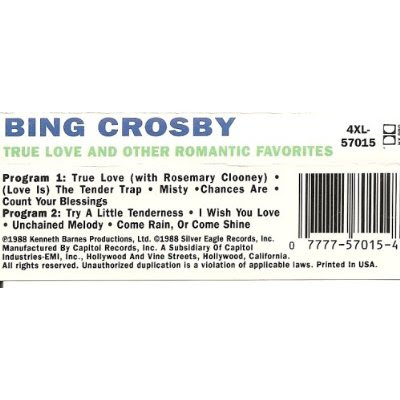
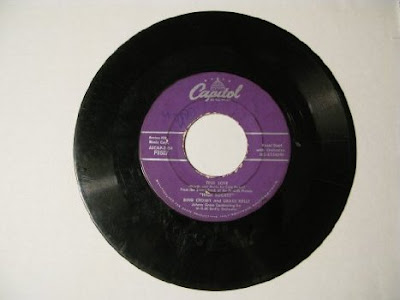
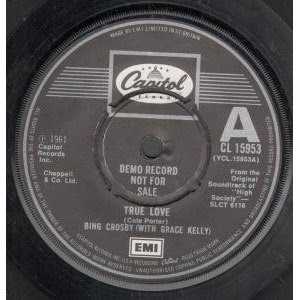
"True Love" was written by Cole Porter, published in 1956. Introduced by Bing Crosby and Grace Kelly in the musical film High Society. The Crosby–Kelly version, accompanied by Johnny Green's MGM studio orchestra, arrangement by Conrad Salinger, was also a popular recorded version of the song. Kelly's contribution on the record is relatively minor, duetting with Bing on only the final chorus. Nonetheless, the single is co-credited to her. True Love is the name of C.K. Dexter Haven's yacht, on which he and Tracy Lord honeymooned off the coast of Maine. They are fictional characters in the play The Philadelphia Story, on which the musical is based.
"True Love" appeared in these analog formats:
Duet with Rosemary Clooney: Duet with Grace Kelly, US release:Duet with Grace Kelly, UK release:Listen to the Crosby-Clooney recording of "True Love" here:
Bing Crosby - "Summer Wind" (Recorded September 1977 and released in 1977). Music by Heinz Meier a.k.a Henry Mayer, lyrics by Johnny Mercer, 1965. Produced by Ken Barnes, arranged by Pete Moore. Recorded at CBS Studios, Whitfield Street, London. From the last album Bing recorded, Seasons. (The visual part of this video is partially irrelevant; someone's self-promotion. The song plays just fine.) Released by Polydor Records on an LP album and cassette tape titled Seasons.Bing also recorded "Summer Wind" for a BBC broadcast, later released on an LP titled The Final Chapter - His Last Songs Ever Recorded.
Bing Crosby With The Pete Moore Orchestra - "That's What Life Is All About" (1975). Produced by Ken Barnes. Recorded in London. Written by Ken Barnes, Bing Crosby, Peter Dacre, and Les Reed. Bing's humble answer to "My Way", at the age of 71. This is one of 15 songs that include a Crosby writing credit. It made the Easy Listening chart in the US, and also the UK Singles Chart.
Released by United Artists Records on a 7-inch 45 rpm single, and an LP album titled That's What Life Is All About. The LP includes a reprise of the song. There's also a "live" video version. Not a lip-sync:
Bing and Gary Crosby With Matty Matlock's All Stars: "Moonlight Bay" (Words by Edward Madden - Music by Percy Wenrich, 1912) Vocal Duet with Orchestra. Decca records, 1951.
The song has been adapted and arranged, but this is not credited on the label of the 7-inch 45 rpm record. The extra words could have come from Bing (who previously had written introductory verses), or perhaps from some uncredited lyricist who wanted to maintain a working relationship with Bing.
The label credit "Featured in Warner Bros. Picture 'On Moonlight Bay'" suggests that perhaps the main purpose of this single was to provide publicity for the 1951 motion picture. (Bing appears to have been under contract to Paramount Pictures at that time.)
"Moonlight Bay" has been recorded by many artists, including Doris Day, Deanna Durbin, Billy Vaughn, and Lawrence Welk.The original words from 1912: Voices hum, crooning over Moonlight Bay Banjos strum, tuning while the moonbeams play All alone, unknown they find me Memories like these remind me Of the girl I left behind me Down on Moonlight Bay
We were sailing along On Moonlight Bay We could hear the voices ringing They seemed to say: "You have stolen her heart" "Now don't go 'way!" As we sang love's old sweet song On Moonlight Bay
Candle lights gleaming on the silent shore Lonely nights, dreaming till we meet once more Far apart, her heart, is yearning With a sigh for my returning With the light of love still burning As in of days of yore
"Violets and Violins" (a.k.a. "Love is Like a Violin"/"Mon Coeur est un Violon") from the 1953 Paramount movie Little Boy Lost. (Music: Miarka/Maria Laparcerie, English lyrics: Jack Lawrence.)